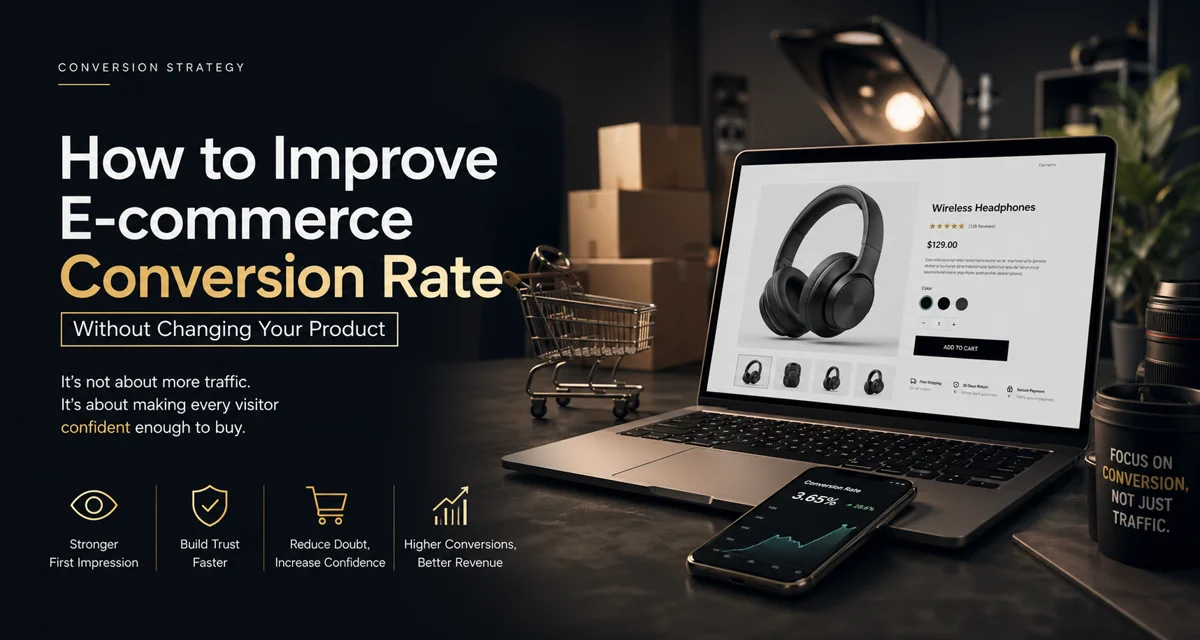
You do not have a product problem. You have a conversion problem.
Because if people are clicking, visiting, even browsing — but not buying — something in your presentation is breaking the sale. It is rarely about price. It is rarely about competition. Most of the time, it comes down to one thing: your product is not being experienced the right way online.
What Most Brands Get Wrong
Most product pages are not bad. They are just average. Nothing clearly broken. Nothing clearly impressive. And that is exactly the problem. Because average does not convert.
When a customer lands on your page, you have a few seconds to build confidence. If your page feels generic, they leave without thinking twice.
How Customers Actually Decide to Buy
Customers do not read your product page from top to bottom. They scan. This is what usually happens:
- They look at your visuals
- They check the price
- They look for quick trust signals
- Only then do they explore details
If your visuals do not build trust instantly, nothing else matters.
The Fastest Way to Improve Conversion Rate
You do not need a complete redesign. You need clarity. Your product page should instantly answer:
- What is this
- Why do I need it
- How does it work
- Can I trust it
If any of these are unclear, your conversion rate drops.
What High-Converting Brands Do Differently
1. They Focus on First Impression
The first visual is not just informative. It drives the decision to stay or leave. It should be clear, premium, and instantly understandable.
2. They Show Real-Life Usage
Products shown in isolation feel incomplete. Customers want to see how it is used, where it fits, what outcome it delivers. This helps them imagine owning it.
3. They Make Benefits Visual
Text explains. Visuals convince. Instead of writing features, they show close-up details, comparisons, and use cases. This reduces decision effort.
4. They Remove Doubt Early
Every buyer has silent questions: Will this fit my needs? Is the quality good? Is it worth the price? Strong visuals answer these before the customer even asks.
5. They Build Perceived Value
Better presentation increases perceived value. Lighting, composition, and layout directly influence how premium your product feels. The product stays the same. The perception changes.
Where Most Brands Go Wrong with AI
AI has made content creation faster. But speed without direction creates noise. Most brands end up producing more images without improving clarity or trust.
At Dobby Ads, the difference is clear. Brands using AI alone create volume. Brands using AI with creative direction improve conversions.
The Shift That Improves Conversions
Most brands ask: how do we get more traffic? High-performing brands ask: why are visitors not converting? That shift changes everything. Because once you fix conversion, every visitor becomes more valuable.
Final Thought
You do not need a better product. You need a better way to present it. Because in e-commerce, your product is experienced visually before it is experienced physically. And that experience decides the sale.
Frequently Asked Questions
What is a good e-commerce conversion rate?
A typical conversion rate ranges between 2% and 4% depending on the category. The focus should be on improving performance over time relative to your own baseline and category benchmarks.
What affects conversion rate the most?
Visual clarity, product presentation, trust signals, and perceived value all play a major role. Of these, your hero image and the first three seconds of the customer experience have the most impact.
Can better visuals increase conversions?
Yes. Clear and realistic visuals reduce hesitation and help customers make faster buying decisions. The key word is realistic — over-polished visuals can actually hurt conversion by creating credibility doubt.
Should I run ads if my conversion rate is low?
It is better to fix conversion first. Driving traffic to a low-converting page leads to wasted spend. Fix the page, then scale traffic.
How does Dobby Ads help improve conversion?
By combining AI tools with creative strategy to design visuals that build trust and improve performance. The focus is on making your product easier to understand, trust, and buy.