Most product visuals fail before customers even read your product description.
In e-commerce, your images and videos are not just supporting elements. They are your first impression, your salesperson, and often your biggest conversion driver. Today, with AI tools, creating product visuals has become easier than ever. You can generate images, build scenes, and create videos within minutes.
But here's the problem: most brands are creating more content, not better content. And that's why conversions don't improve.
Why Most Product Visuals Don't Convert
A lot of e-commerce brands assume that if their visuals look good, they will perform well. That's not always true. Most product images and videos fail because they:
- Focus on aesthetics instead of clarity
- Don't highlight key product benefits
- Overwhelm or confuse the viewer
- Lack consistency across listings and ads
Customers don't spend time analyzing your visuals. They scan. If your visuals don't communicate quickly and clearly, you lose attention and potential sales.
What High-Converting Product Images Actually Do
High-performing product images are not just visually appealing — they are designed for conversion. They:
- Clearly showcase the product
- Highlight key features and benefits
- Use clean, distraction-free composition
- Guide the viewer's attention
- Maintain consistent branding
A good product image shows the product. A high-converting product image shows why the product is worth buying.
The Image Stack That Converts
Instead of random visuals, high-performing brands typically use a mix of:
- Clean main product image — for clarity and compliance
- Feature-focused images — highlighting specific benefits with callout graphics
- Lifestyle images — showing real usage in relatable contexts
- Comparison visuals — showing advantages over alternatives
This combination helps customers understand the product quickly and builds trust through every stage of the decision.
Why Product Videos Are Now Essential
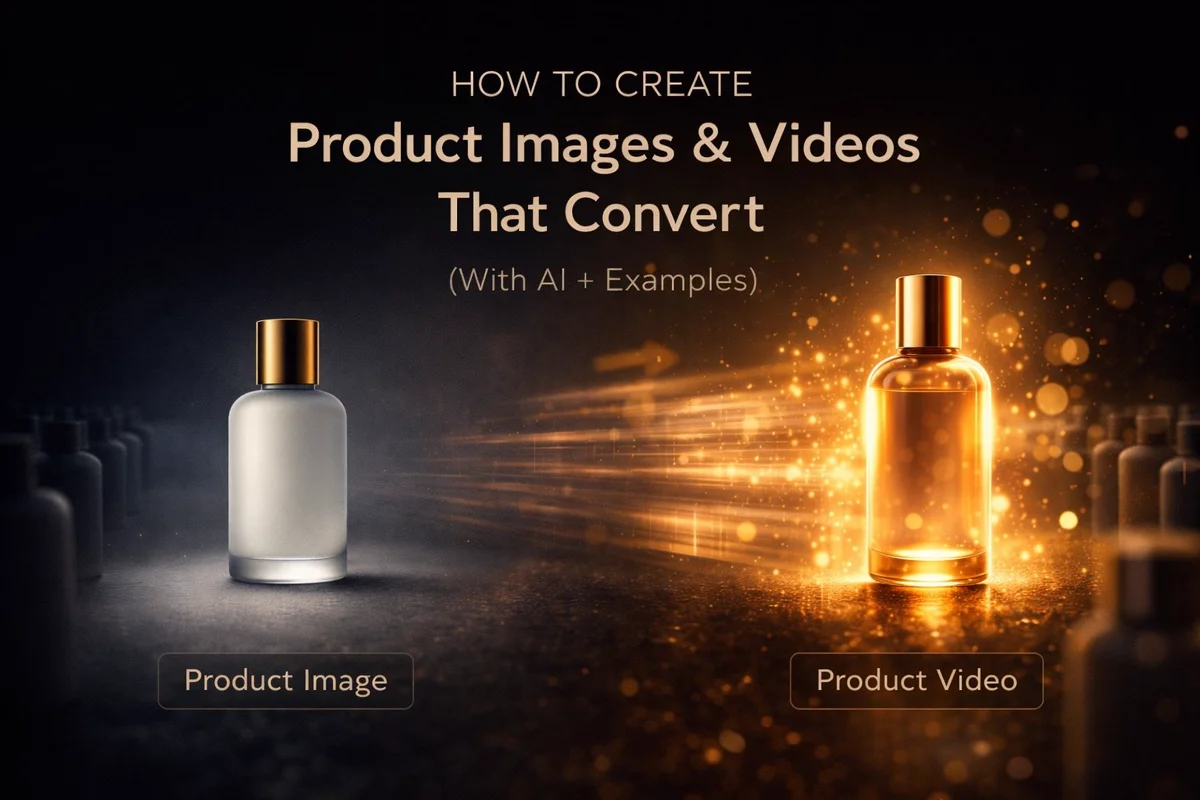
Images get attention. Videos build confidence.
Today, customers expect to see products in action. They want to understand how the product works, what it looks like in real life, and how it fits into their lifestyle. Short-form videos — especially for ads and product pages — can:
- Increase engagement and time on page
- Improve product understanding dramatically
- Reduce hesitation and pre-purchase doubt
- Boost conversion rates meaningfully
In many cases, adding a simple product video can significantly improve performance on its own.
How to Use AI for Product Images and Videos
AI has made it easier to create both images and videos at scale. Brands can now use tools to:
- Generate product images quickly with consistent styling
- Create lifestyle scenes without expensive photoshoots
- Build short product videos and dynamic ad content
- Test multiple creative variations at low cost
For images, tools like ChatGPT image generation and Midjourney help with concept creation and visual production. For videos, platforms like Runway allow brands to generate short product clips and dynamic content. This makes content creation faster and more accessible than ever.
Where Most Brands Struggle With AI
AI tools are powerful, but they don't solve everything. Most brands struggle because:
- They generate inconsistent visuals without a clear brand system
- They focus on quantity instead of quality and purpose
- They lack a clear creative direction to guide outputs
- They don't optimize for specific platforms like Amazon or Meta ads
AI can generate outputs. But it doesn't automatically create a cohesive, conversion-focused visual system. This is why many brands end up with a lot of content, but little improvement in performance.
Tools vs. Systems
AI tools give you speed. But conversion comes from systems. Brands that rely only on tools often create disconnected visuals, inconsistent messaging, and low-performing creatives. Brands that build structured systems can maintain consistency, improve clarity, scale effectively, and increase conversions.
The goal is not just more content. It's better-performing content. At Dobby Ads, we combine AI-generated product visuals with structured creative direction, e-commerce-focused design, and scalable production workflows — so brands get content that actually drives results.
Final Thoughts
Creating product visuals has never been easier. But creating visuals that actually convert still requires strategy. Images grab attention. Videos build trust. AI speeds up the process. But without structure and direction, even the best tools fall short.
The brands that succeed are not the ones creating the most content. They are the ones creating content that works.
Frequently Asked Questions
What makes product images high-converting?
High-converting product images clearly communicate product benefits, maintain visual consistency, and guide customer attention effectively toward the buying decision.
Are product videos necessary for e-commerce?
Yes. Product videos help customers understand the product better, build trust, and often meaningfully improve conversion rates — especially in categories where fit, function, or scale matters.
Can AI create product images and videos?
Yes. AI tools can generate both images and videos quickly, making content creation faster and more scalable. The key is combining AI speed with creative strategy.
Why don't AI-generated visuals always perform well?
Because they often lack creative direction, consistency, and conversion-focused design. AI generates outputs, but strategy determines whether those outputs actually drive sales.
Does Dobby Ads help with both images and videos?
Yes. Dobby Ads helps e-commerce brands create AI-powered product images and videos designed for performance and scalability across Amazon, Shopify, and DTC channels.